


Choosing the Right Lighting for Different Rooms
Combine ambient, task, and accent lighting to make each space practical for daily life while still feeling warm and inviting.

Start with Layers, Not a Single Ceiling Light
Most British homes still rely on one pendant in the middle of the ceiling, switched on at dusk and left on until bedtime. It is the cheapest way to light a room and, unfortunately, the least flattering. The answer is to build three layers instead: ambient light that fills the space, task light where you actually read, cook or shave, and accent light that adds depth. When all three work together, a room feels warm and finished. When only ambient light exists, the same furniture can look flat and slightly institutional.
As a starting point, keep living areas warm with bulbs rated between 2200K and 2700K, and reserve anything cooler for utility spaces. It is also worth checking that your dimmer is compatible with the LED bulbs you buy — a mismatched pair will flicker or buzz, and no amount of styling will fix that.
- Ambient: ceiling fittings, wall uplighters or a pair of matching table lamps on opposite sides of the room.
- Task: a reading lamp, an under-cabinet strip in the kitchen, angled light beside a mirror.
- Accent: a picture light over a mantelpiece, a small lamp on a bookshelf, a wash of light up a chimney breast.
Living Rooms: Aim for Three Pools of Light
A good sitting room usually has at least three separate light sources, and a pendant is only one of them. In a Victorian terrace with a bay window, a standard lamp in the alcove beside the chimney breast works beautifully, paired with a smaller lamp on the opposite side and a picture light or floor uplighter in the corner. The aim is to avoid dark corners; light arriving from several directions makes a room feel bigger and softer.
If you do keep the central pendant, fit a dimmable bulb and treat it as background rather than headline lighting. A dimmer on a two-way switch, by the door and beside the sofa, is one of the cheapest upgrades in the house. For a more traditional feel, a fabric shade in warm cream or oatmeal diffuses light gently and stops bulbs reflecting off a television screen.
Kitchens and Dining Areas
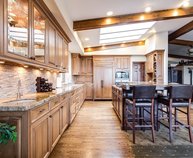
Kitchens need more light than any other room because the work is fiddly and often done in the shadow cast by your own hands. Layering matters here: a general wash of light from the ceiling, then focused light on the worktops. Under-cabinet strips are the single most useful addition, fitted along the front edge of wall units so they light the surface rather than the back of the cupboard.
Above a dining table or island, use pendants hung low — roughly 75cm above a worktop, or 65–70cm above a table — and choose shades that direct light downwards rather than glaring into the room. Two smaller pendants usually look better than one large one over a long island. Keep the colour temperature consistent with the rest of the house; a sudden jump to cool white will make the kitchen feel like a different building.
Bedrooms: Soft, Low and Independently Switched
Bedrooms should be the warmest and dimmest rooms in the house. Recessed downlights directly above a bed are unforgiving at any time of day, and worse when you are lying on your back. Instead, put a lamp on each bedside table, or wall-mount a reading light on an articulated arm so you can angle it away from the person beside you.
- Choose bulbs around 2200–2700K for a warm, candle-like glow.
- Use separate switches for each side of the bed so one person can read while the other sleeps.
- Add a small lamp on a chest of drawers for gentle ambient light while you dress.
- Keep overhead lighting on a dimmer so you can lower it in the evening rather than switch it off entirely.
Bathrooms and Hallways
Bathroom lighting is mostly about faces. Light from directly overhead casts shadows under the eyes and nose, so place fittings either side of a mirror at roughly face height, or use a single light above it angled forward. Anything within reach of a bath or shower must be properly rated for the zone — IP44 is the minimum for a bathroom, and higher closer to water. It is not worth cutting corners here; a qualified electrician will advise on zoning.
Hallways and landings are often the darkest and most neglected spaces. Light the length of a hall rather than its centre, using two or three smaller fittings, and let the eye travel. A lamp on a hall table or console makes an entrance feel welcoming and gives you a reason to leave the light on in the evening. Motion sensors can work well on stairs, though choose a warm setting and a short timer so it feels helpful rather than clinical.
Bulbs, Switches and the Details that Matter
Whatever you choose, buy bulbs in one go and from the same range, so the colour temperature is identical across a room. Check the lumen output rather than the wattage on LED packaging: roughly 400 lumens for a bedside lamp, 800 for a main ceiling fitting. A dimmer that suits the bulb, plus a warm white LED, will do more for the atmosphere of a British home than any amount of new furniture. Get the layers right and each room will work harder during the day and feel kinder at night.

Post a comment